
Safety data sheet
Standardized safety protocols and material specifications for professional use.
Certificate of Analysis
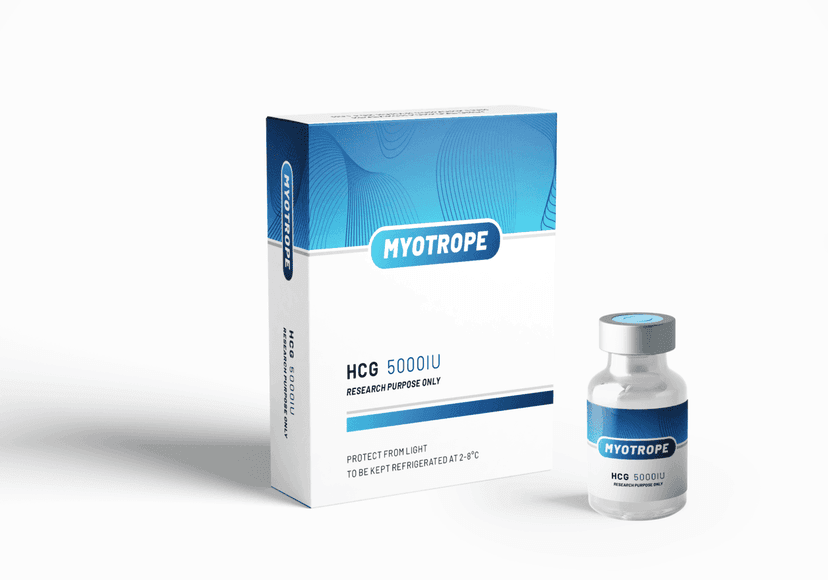
Purity verified via High-Performance Liquid Chromatography (HPLC) for #myo-hcg-5000iu
HCG (5000IU)
High >98% Purity
Authorized Resellers
Available through our trusted partners
123peptide.com
Netherlands · Europe
local_shipping2-3 Business Days
Depeptidenwinkel.com
Netherlands · Europe
local_shipping2-3 Business Days
Scientific Background
Human Chorionic Gonadotropin (HCG) is a glycoprotein hormone naturally produced by the placenta during pregnancy. Structurally, it shares an identical alpha subunit with LH, FSH, and TSH, while its unique beta subunit confers specificity for the LH/hCG receptor on testicular Leydig cells and ovarian granulosa cells.
HCG's primary pharmacological action in male reproductive research is the stimulation of Leydig cell testosterone synthesis — the same receptor pathway as endogenous LH, but with a substantially longer half-life (~24–36 hours versus 60 minutes for LH). This extended activity makes HCG effective for maintaining intratesticular testosterone and gonadal volume when endogenous LH is suppressed.
Research applications include preserving testicular function during exogenous testosterone administration, post-cycle HPG axis recovery, fertility support in hypogonadotropic hypogonadism, and as a diagnostic tool for assessing Leydig cell reserve. HCG is one of the most extensively studied gonadotropins in both male and female reproductive medicine.
Intended Research Use
- Intratesticular testosterone maintenance during HPG axis suppression
- Testicular volume and function preservation studies
- Post-cycle gonadotropin recovery protocols
- Hypogonadotropic hypogonadism fertility research
- Spermatogenesis support alongside HMG/FSH
- LH receptor agonism studies (Leydig cell models)
menu_bookScientific Publications
Journal of Clinical Endocrinology & Metabolism (2005)
Low-dose human chorionic gonadotropin maintains intratesticular testosterone in normal men with testosterone-induced gonadotropin suppression
open_in_newhttps://pubmed.ncbi.nlm.nih.gov/15713727/
Translational Andrology and Urology (2018)
Indications for the use of human chorionic gonadotropic hormone for the management of infertility in hypogonadal men
open_in_newhttps://pubmed.ncbi.nlm.nih.gov/30159241/
Translational Andrology and Urology (2020)
Human chorionic gonadotropin treatment for management of secondary hypogonadism and infertility in men with anabolic steroid-induced hypogonadism
open_in_newhttps://pubmed.ncbi.nlm.nih.gov/33345656/
FOR RESEARCH USE ONLY. This product is intended for laboratory research purposes only and is not for human consumption, medical, or diagnostic use.
Possible stacks with other peptides
Synergistic combinations for enhanced research outcomes
HCG is commonly combined with complementary gonadotropins for comprehensive hormone axis restoration and fertility research protocols.
HMG 75IU (75IU vial)
arrow_forwardmyo-hmg-75iu
Spermatogenesis completion — HCG stimulates Leydig cell testosterone while HMG's FSH activity drives sertoli cell-dependent spermatogenesis, providing full gonadotropin axis coverage for fertility research.
Gonadorelin Acetate (2mg vial)
arrow_forwardmyo-gonadorelin-acetate-2mg
HPG axis dual stimulation — gonadorelin drives upstream pituitary LH/FSH release while HCG provides direct gonadal stimulation, creating layered support for comprehensive axis recovery research.
Cycling Note: Maintenance protocols run 8–16 weeks. Recovery protocols: 4 weeks high-dose, tapering over weeks 5–8. Monitor hormonal markers throughout.